

New mothers average 4.3 nighttime wake-ups in the first three months postpartum, and every minute spent fumbling with complicated clothing is a minute stolen from precious sleep. Most moms accept this exhaustion as unavoidable, but the right nighttime nursing wear can genuinely change that equation. From faster breast access to healthier lactation, what you wear to bed during the nursing months is one of the most underrated decisions you can make for your recovery, your milk supply, and your overall wellbeing.
Table of Contents
- The science behind nighttime nursing: Why wear matters
- What to look for in nighttime nursing wear
- Material matters: Comfort, breathability, and sweat control
- How smart design supports better sleep and milk supply
- What most new moms miss about night nursing comfort
- Find the perfect nighttime nursing wear for you
- Frequently asked questions
Key Takeaways
| Point | Details |
|---|---|
| Save sleep time | Specialized nursing wear shaves down each nighttime feeding, compounding to hours of extra rest each week. |
| Support lactation health | Easy-access designs and soft fabrics help maintain milk supply and reduce mastitis risk. |
| Choose smart materials | Bamboo and moisture-wicking fabrics keep you cool and comfortable through postpartum night sweats. |
| Prioritize function first | Features like wire-free support, quick closures, and gentle seams are essential for restful nights. |
| Invest in recovery | The right nighttime wear protects your sleep, supports breastfeeding, and makes new-mom life easier. |
The science behind nighttime nursing: Why wear matters
Nighttime feeding is not just inconvenient; it is uniquely taxing on your body and your biology. When your baby cries at 2 a.m., your cortisol spikes, your body temperature shifts, and you are suddenly wide awake in the middle of what should be your deepest sleep. Getting back to sleep quickly after a feed is crucial, which is why every second of that process genuinely counts.
What most people do not realize is that nighttime breast emptying is critical for maintaining milk supply. Your body reads overnight feeding patterns to regulate how much milk to produce. If those feeds are skipped, delayed, or incomplete because your clothing makes the process awkward or uncomfortable, your supply can drop faster than you expect.
“Specialized nursing sleepwear provides light support without wires or tight elastics, accommodating postpartum breast changes and engorgement while allowing restful sleep.” — Nanit nursing bra guide
Your postpartum breasts are not the same as your pre-pregnancy breasts. They engorge rapidly, they are sensitive to pressure, and they change size multiple times a day. Standard pajamas with built-in shelf bras, or wearing a regular bra to bed, can press against milk ducts and interrupt drainage. That pressure, repeated night after night, is a fast track to plugged ducts and mastitis, a painful breast infection that can derail your entire breastfeeding journey.
The sleepwear benefits of purpose-built nursing wear go well beyond convenience. Non-restrictive support keeps your breasts comfortable through engorgement cycles while still offering enough structure to feel stable as you sit up, latch your baby, and settle back down.
Key risks of wearing the wrong sleepwear at night:
- Compressed milk ducts leading to painful clogs
- Increased mastitis risk from poor drainage
- Reduced milk supply from inconsistent nighttime emptying
- Disrupted sleep from discomfort and difficult clothing removal
- Skin irritation from scratchy seams or synthetic fabrics against tender breast tissue
Pro Tip: Choose a wire-free nursing sleep bra with one-handed drop-down cups so you can access your breast and latch your baby without turning on the lights or fully sitting up.
What to look for in nighttime nursing wear
Now that you understand the stakes, let’s break down exactly what separates effective nighttime nursing wear from everything else on the market.
The non-negotiables come down to five core features: wire-free construction, adjustable or stretchy straps, one-handed nursing clips or pull-aside panels, soft and breathable fabric, and a relaxed enough fit to accommodate breast size changes throughout the night. Miss any one of these and you will feel it by 3 a.m.
| Feature | Typical pajamas | Regular bra | Nursing sleepwear |
|---|---|---|---|
| Breast access speed | Slow, requires full undressing | Moderate, hooks or straps | Fast, one-handed clips or pull-aside |
| Support level | Minimal or none | Firm but often too restrictive | Light, flexible support |
| Risk of duct compression | Low | High (especially underwire) | Very low |
| Fabric breathability | Varies | Usually synthetic | Designed for moisture wicking |
| Postpartum size changes | No accommodation | No accommodation | Stretchy and adjustable |
| Comfort for sleep | Moderate | Poor | Optimized for rest |
Tight or underwire bras at night risk compressing milk ducts, leading to clogs or mastitis, so the wire-free requirement is not a comfort preference; it is a clinical recommendation backed by lactation specialists.
For moms with larger busts, the calculus gets a little more nuanced. You need enough structure to prevent the back discomfort that comes from lying on your side unsupported, but that structure cannot come from an underwire. A well-fitted racerback nursing sleep bra in a stretchy, supportive fabric solves this perfectly, distributing weight evenly across your shoulders and upper back while keeping milk ducts free and clear.
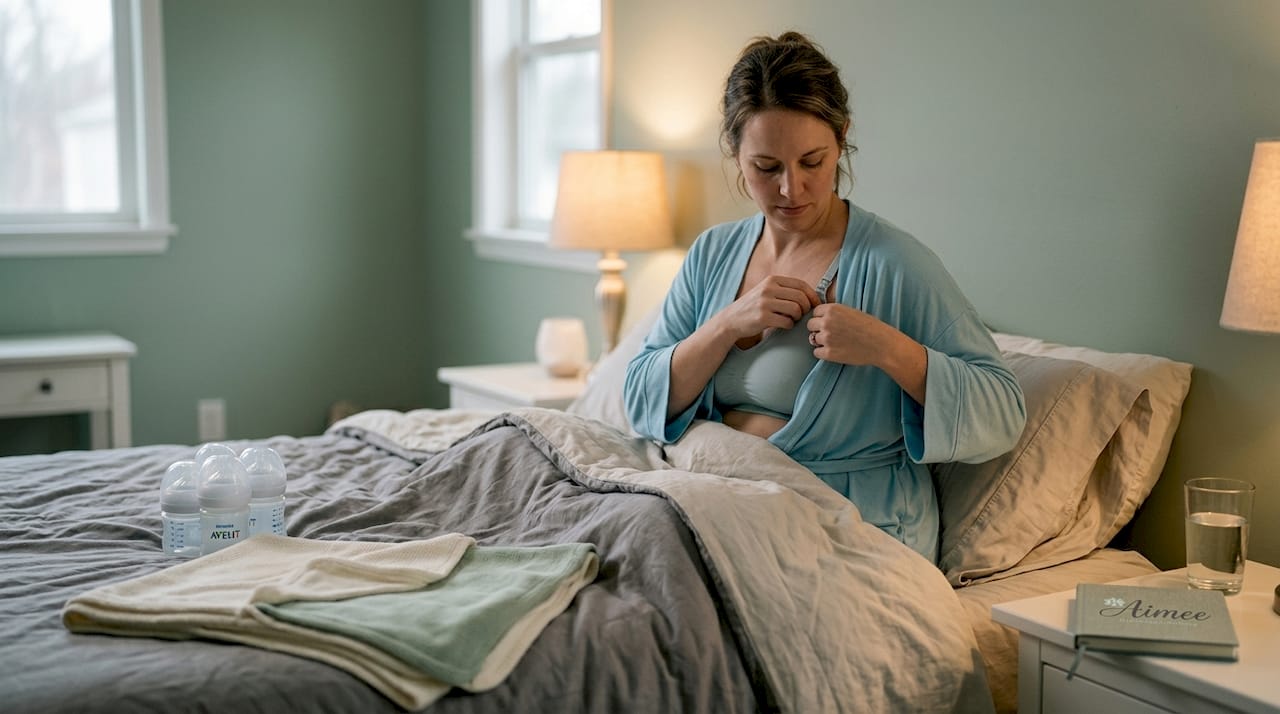
Fabric sensitivity is also a real postpartum issue. After delivery, hormonal shifts can make your skin temporarily reactive to synthetic fibers, rough seams, and tight bands. Pairing thoughtful construction with postpartum recovery tips and skin-safe fabrics like bamboo or modal means you are protecting both comfort and skin health simultaneously.
Watch out for these common nursing sleepwear red flags:
- Tight elastic bands around the ribcage or chest
- Scratchy or raised interior seams near breast tissue
- Double-handed closures that require full dexterity at 3 a.m.
- Synthetic-only fabrics that trap heat
- Non-stretch cups that cannot expand with engorgement
- Thin shelf bras with no actual lift or structure
When you shop comfortable nursing gowns and sleepwear options, filtering by these criteria first will save you from purchasing something that looks great but fails in practice.
Material matters: Comfort, breathability, and sweat control
Once you have the right structure, the fabric underneath everything else becomes the deciding factor in how well you actually sleep. This is especially true postpartum, because your body is actively working to regulate hormones, shed retained fluids, and cool itself, all while producing milk.
Postpartum night sweats affect 29% of new mothers, and bamboo fabric wicks moisture three times more effectively than standard cotton. That is not a marketing claim; it is a measurable performance difference that plays out directly on your skin at 4 a.m.
| Fabric | Moisture wicking | Softness | Temperature regulation | Durability |
|---|---|---|---|---|
| Bamboo | Excellent (3x cotton) | Very soft, silky feel | Superior | Moderate |
| Cotton | Moderate | Soft | Good | High |
| Modal | Good | Extremely soft | Good | Moderate to high |
| Polyester | Poor | Variable | Poor (traps heat) | High |
| Blends | Varies | Varies | Varies | High |
Bamboo fabric has a natural antimicrobial quality that reduces odor, which matters when you are sweating overnight and may not have time for daily washing. Modal, a fabric made from beech tree pulp, is another strong choice for its buttery texture against postpartum skin that may be recovering from sensitivity or stretch marks.
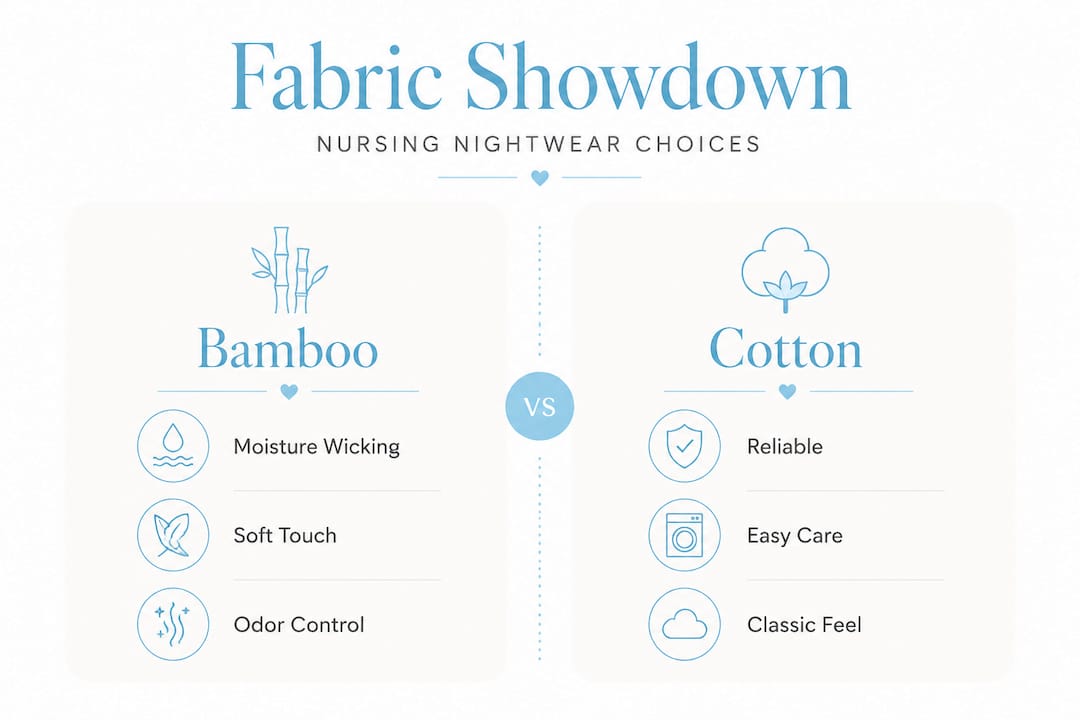
Cotton remains a reliable classic, especially for moms who run warm and want a fabric that is easy to care for and widely available. However, 100% cotton can take longer to dry when wet from night sweats or milk leaks, which is why many of our best-loved pieces use cotton-modal or cotton-bamboo blends for the best of both worlds.
The bamboo nursing tank is a great example of how the right material choice changes the entire wearing experience. Paired with the bamboo postpartum lounge short, it creates a sleep set that actively works with your body rather than against it.
Signs that your current sleepwear fabric is not working for you:
- Waking up damp or overheated regularly
- Skin irritation, redness, or itching near fabric edges
- Rashes or chafing around the bra band or strap area
- Fabric feeling heavy or clingy after sweating
- Strong odor after a single night of wear
Pro Tip: Pre-wash new nursing sleepwear with a fragrance-free, dye-free detergent before wearing it for the first time. Postpartum skin is more reactive than usual, and even new fabric finishes can trigger irritation.
How smart design supports better sleep and milk supply
Material is the foundation, but design is what turns nursing wear from simply comfortable into genuinely life-improving. This is where thoughtful engineering creates real, measurable results in your nightly routine.
Consider how a single nighttime feed actually unfolds. Your baby wakes. You hear the cry. Your body responds. You sit up, reach over, and then spend the next 30 to 90 seconds wrestling with buttons, straps, or layers before your baby even latches. That delay increases your wakefulness, increases your baby’s distress, and adds cortisol to a moment that should be calm and brief.
Here is what a well-designed nursing session looks like with the right wear:
- Baby stirs or cries, and you wake naturally
- You sit up in one smooth motion, no complicated unzipping
- One hand releases the nursing clip or slides the panel aside
- Your baby latches within seconds, in the dark, without a struggle
- The feed completes calmly, and you re-clip with one hand
- You settle back to sleep within minutes of the feed ending
That process, when optimized, is faster and calmer than most moms imagine is possible. Reducing feeding time by seconds or minutes each night compounds to hours of extra sleep over weeks and months. Over a three-month period with 4.3 nightly wake-ups, saving just two minutes per feed adds up to more than 15 additional hours of rest. That is not a trivial number when you are running on interrupted sleep.
There is also a direct lactation benefit. Functional wear lets you empty breasts at night without fully undressing, helping maintain milk supply by enabling complete, consistent feeds even when you are barely awake. Anything that makes those feeds slower, more stressful, or less complete undermines your supply over time.
Quick breast access also reduces the stress hormones that interfere with your letdown reflex. When you are fumbling with clothing, your body registers mild stress, which can delay milk release and extend feeding time. Smooth, intuitive access supports a faster letdown and a calmer baby.
Explore the full range of breastfeeding essentials to pair your nursing sleepwear with accessories that support the complete nighttime feeding setup.
Pro Tip: Keep a spare nursing sleep bra and a clean top folded on your nightstand. Milk leaks and spit-up happen at unpredictable moments, and being able to change quickly without hunting through drawers at 3 a.m. eliminates a surprising amount of nighttime stress.
What most new moms miss about night nursing comfort
Here is something that took years of working with postpartum mothers to understand fully: most of the exhaustion and frustration that moms attribute to “just having a newborn” is at least partially caused by friction in the nighttime routine, and nightwear is often the biggest, most fixable source of that friction.
Moms consistently invest in feeding pillows, sound machines, white noise apps, and blackout curtains. These are all valid. But they frequently wear whatever pajamas they already owned pre-pregnancy, or they grab a basic nursing bra that technically has clips but makes opening them feel like defusing a device in the dark.
That choice does not feel significant in the daylight. But at 2 a.m., 4 a.m., and 5:30 a.m., it accumulates. The frustration of a difficult clasp when you are sleep-deprived is disproportionately demoralizing. The discomfort of a too-tight band when your breasts are engorged is quietly exhausting. These micro-stressors add up to bigger mood impacts, lower patience, and a harder postpartum experience overall.
A practical sleep bra that actually works in the dark is not a luxury purchase. It is an investment in your mental health, your sleep quality, and your ability to sustain breastfeeding long enough to reach your personal goals.
The contrarian truth here is that skimping on nightwear to save money often costs more in the end, through lactation consultant visits for supply issues, mastitis treatment, or simply the invisible toll of months of worse sleep than necessary. Investing in proper nursing sleepwear is not vanity; it is vital self-preservation for the person doing the hardest job in the room.
Pro Tip: Prioritize function over fashion when choosing nighttime nursing wear; if you find both in one piece, that is a win worth celebrating.
Find the perfect nighttime nursing wear for you
Ready to transform your nighttime nursing routine? The difference between surviving those early months and genuinely recovering through them often comes down to the small decisions you make about what you wear to bed.
At NursingGowns.com, every piece in our collection was designed with your 3 a.m. reality in mind. From nursing gowns and sleep-ready nursing tops for night feeding to supportive sleep bras and breathable bamboo sets, you will find options that make nighttime feeds faster, more comfortable, and far less stressful. Browse our full range of shop nursing sleepwear options alongside curated milk storage and accessories to create a complete nighttime setup that works as hard as you do. You have earned comfort that actually supports you.
Frequently asked questions
Why shouldn’t I use my regular bra or pajamas for nighttime nursing?
Regular bras can compress milk ducts and increase the risk of mastitis, while standard pajamas lack the easy breast access and flexible support that nighttime feeds require; tight underwire bras are especially risky during the postpartum period.
Can wearing nursing bras at night really help with milk supply?
Yes, because nighttime breast emptying is critical for maintaining milk supply, and a well-designed nursing bra makes it easier to complete those feeds efficiently without skipping or cutting them short.
What material is best for nighttime nursing wear?
Bamboo is often the top choice because it wicks moisture 3x better than cotton, which is particularly important for the roughly 29% of postpartum women who experience significant night sweats.
How many pieces of nighttime nursing wear do I need?
Most nursing moms benefit from keeping at least two to three pieces on rotation to handle milk leaks, spit-up, and overnight sweating without running out of clean options between laundry days.
Are there specific designs for larger bust sizes?
Wireless nursing sleep bras with racerback or wide-strap construction are specifically designed to offer adequate support without back strain for larger busts, making them a much safer and more comfortable overnight option than underwire alternatives.